
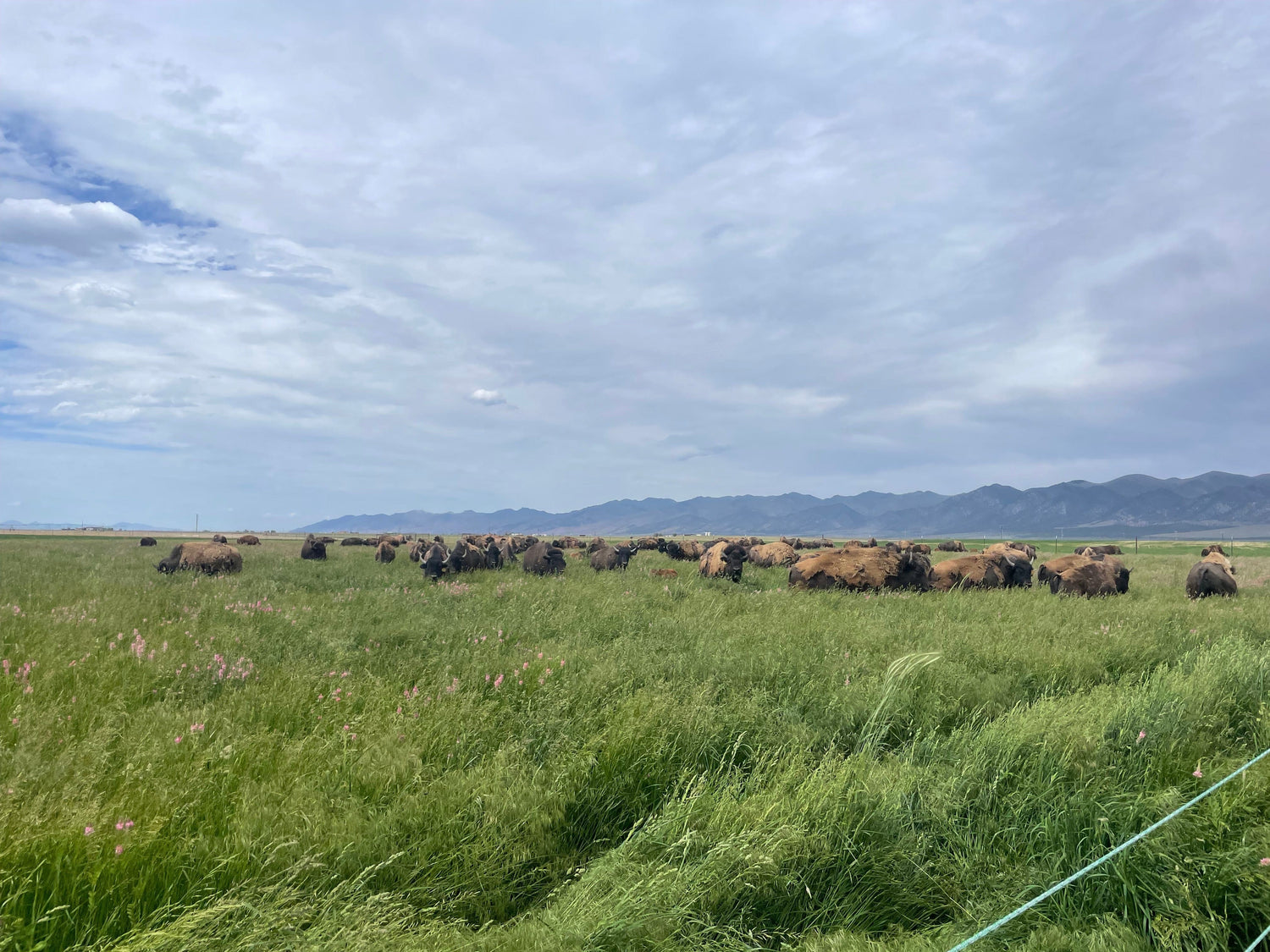
Watch a bison for an hour and you'll see it do exactly one thing: eat. Head down, moving slowly, working across the ground like it's on a schedule only it can see. It's the least mysterious animal on earth in that way — and yet "what do bison eat" is one of the questions we hear most, from kids at the farmers market and from adults deciding what they think about grass-fed meat.
So here's the full answer, from people who spend their days managing the salad bar.
The Short Answer: Grass, Overwhelmingly
Bison are grazers, and grass is the job. Native grasses, sedges, and a supporting cast of forbs — the broadleaf plants mixed through any healthy pasture — make up the overwhelming majority of what a bison eats, wild or ranched. They'll sample shrubs and browse when the grass runs thin, but given the choice, a bison is a grass specialist with a grass specialist's equipment: a huge rumen for fermenting tough forage, and a massive head built to swing along the ground all day.
That's the trait that shaped a continent. Tens of millions of bison once moved across the Great Plains eating grass, fertilizing as they went, and the grassland evolved to be eaten by them. Bison and prairie built each other — which is why a well-managed bison herd doesn't degrade pasture, it improves it.
How Much Does a Bison Eat?
A lot, delivered slowly. A mature bison works through roughly 25 to 30 pounds of forage a day, spending nine to eleven hours grazing to get it. They eat in unhurried shifts — graze, then lie down to chew cud, then graze again — because like cattle, bison are ruminants: the food ferments in stages, and the cud-chewing is round two of a four-chambered digestive process that turns rough grass into one of the leanest, most nutrient-dense red meats there is.
What Do Bison Eat in Winter?
The same thing, with more effort. This is the part of the bison diet that genuinely amazes people: bison don't stop grazing when snow buries the pasture. They swing those enormous heads like snowplows — it's what the head is for — sweeping drifts aside to reach the cured grass underneath. A bison can graze through snow that would defeat cattle entirely, which is a big part of how the species survived Plains winters for thousands of years without anyone hauling hay to them.
On working ranches, most operations (ours included) supplement hard winters with hay — dried grass, so the diet doesn't actually change, just the delivery method. What matters is what the hay is and isn't: forage, not grain.
Wild Bison vs. Ranched Bison: Does the Diet Differ?
Less than you'd think — until the very end, where it can differ completely.
A wild bison in Yellowstone and a well-ranched bison in Nevada eat essentially the same diet: grass and forage, season after season, for life. The fork in the road comes at finishing. A lot of commercial bison spends its final months in a feedlot eating grain to fatten quickly — same playbook as commodity beef. A grass-finished bison never makes that stop. We wrote a whole post on grass-fed versus grain-finished bison, because that last chapter of the diet changes the fat in the meat, the flavor, and frankly the honesty of the label.
Our herd's answer: grass and forage from first day to last, on pasture outside Eureka, Nevada, with hay when the high desert winter demands it. No grain, no feedlot, no exceptions.
What Bison Don't Eat
Worth saying plainly, because the feed store version of the animal confuses people: bison aren't natural grain eaters. Corn and grain put weight on fast, which is why feedlots use them, but nothing about a bison's digestive system evolved for that diet — it runs best on exactly the rough, fibrous forage the Plains always provided. Bison also aren't browsers the way deer and elk are; leaves and woody shrubs are a fallback, not a preference. And no, despite what one kid at the market asked us: they do not eat smaller animals. The scariest-looking animal on the ranch is a committed vegetarian.
Why the Diet Is the Whole Story of the Meat
Here's why this question deserves a longer answer than "grass": what a bison eats is what a bison is. A life spent converting grass into muscle produces meat that's dramatically leaner than beef, deeper in flavor, and carrying a better fat profile — more omega-3s, more CLA — than grain finishing allows. When people taste our bison and say it tastes clean, they're tasting a diet. The pasture is the recipe.
That's also why we manage our ground regeneratively — rotating the herd, resting the pasture, converting more of our acreage to managed forage as the herd grows. Better grass raises better bison. There's no shortcut in that loop, and we wouldn't take one if there were.
The Bottom Line
Bison eat grass — in summer by choosing it, in winter by digging for it, and on an honest ranch, for every day of their lives. Everything people love about bison meat traces back to that one stubborn fact.
Want to taste what a lifetime of Nevada grass produces? Ground bison is the easy first step, and our pricing breakdown explains what raising them this way costs and why.
Questions about the herd or the pasture? Call 1-775-318-0366 — Anthony can talk grass longer than you can listen.

Leave a comment
This site is protected by hCaptcha and the hCaptcha Privacy Policy and Terms of Service apply.