
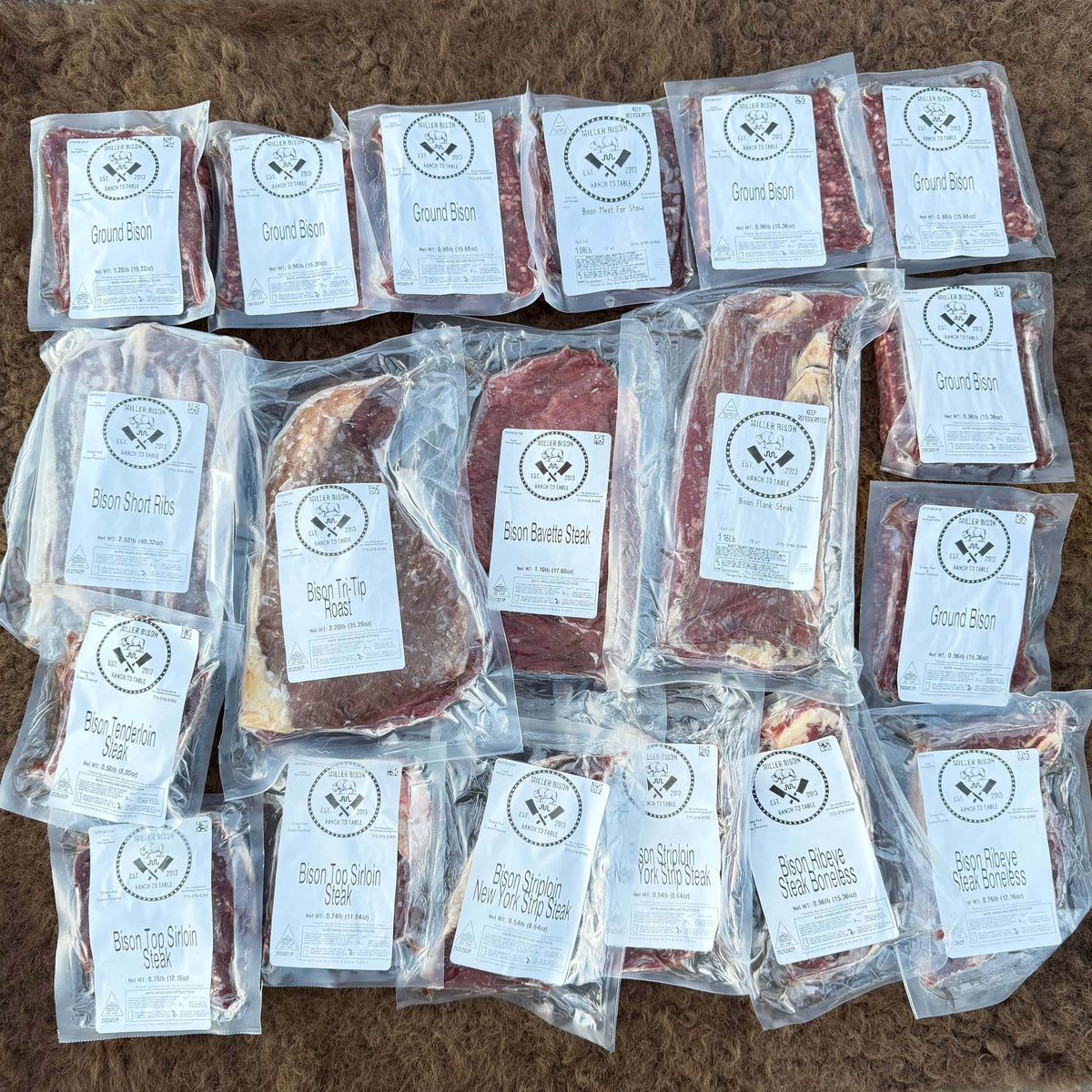
Ask a butcher to walk you through a beef animal and you'll get a familiar tour — everybody knows the ribeye neighborhood, the brisket district, the ground-beef suburbs. Ask about bison and the map is almost the same, with two big differences: every cut behaves leaner than its beef twin, and a couple of cuts on this animal don't exist on a steer at all.
We cut meat for a living, so here's the full tour — what each cut is, how it wants to be cooked, and honest guidance on what to buy first. Settle in; the animal is big and we're going nose to tail.
First, the One Rule That Governs Every Cut
Bison is dramatically leaner than beef, and that changes the cooking math on every single cut below the same way: hot and fast or low and slow, and pull it early. Tender cuts want a hard sear and an early exit; hardworking cuts want hours and moisture. What no bison cut tolerates is the lazy middle — medium heat, no attention, no protection. Keep that one rule in your pocket and everything below gets easy.
The Steakhouse Cuts
Ribeye and Prime Rib
The ribeye is the most marbled real estate on a bison — which, on this animal, means "pleasantly rich" rather than "swimming." Deep, beefy-but-cleaner flavor, and the cut most likely to convert a skeptic in one bite. Cook it like the best steak you own: screaming pan or grill, medium-rare, five-minute rest. The same muscle left whole becomes a boneless ribeye roast — bison's answer to prime rib and the single best holiday centerpiece we sell. Roast it low, finish it hot, and carve at the table for full effect.
Tomahawk
A ribeye with the full rib bone left long — part steak, part scepter. The bison tomahawk is the showpiece cut: big enough to share, dramatic enough that dinner becomes an event. Cook it two-zone — sear hard over the hot side, finish gently on the cool side — because its thickness will outrun a single-temperature fire. If you're cooking to impress exactly once this year, this is the cut.
New York Strip
The strip is the steak-lover's steak — firmer chew than ribeye, big mineral flavor, clean edges. Bison New York strips run leaner than their beef twins, so they punish inattention a little harder and reward a thermometer a little more. Salt, sear, 125–130°F, rest. Done.
Tenderloin and Filet
The tenderest muscle on the animal, because it's the one that barely works. Bison tenderloin is butter-soft with a delicate flavor — the cut for people who prize texture above all, and the one where overcooking is most expensive in every sense. Rare to medium-rare, nothing further, no exceptions.
Top Sirloin
The value athlete: honest steak flavor, satisfying chew, friendlier price than the glamour cuts. Sirloin is our pick for weeknight steaks, steak salads, kebabs, and anyone learning to cook bison — enough forgiveness to practice on, enough quality to enjoy while you learn.
The Butcher's Secret Cuts
These are the cuts butchers historically took home themselves — smaller, stranger-shaped, and packed with more flavor per ounce than anything in the display case.
Flat Iron
Cut from the shoulder, the flat iron is second only to tenderloin in tenderness with three times the personality. It sears beautifully, slices into perfect fajita and steak-salad ribbons, and costs less than the fame cuts. If you see a bison flat iron available, buy it — it's the best flavor-per-dollar steak on the animal.
Bavette (Flap Steak)
The bavette is a loose-grained, deeply beefy cut from the bottom sirloin — France's favorite bistro steak, and increasingly the in-crowd's favorite bison cut. Its open grain drinks up marinades and chars gorgeously over high heat. Cook fast, rest, and slice against the grain at an angle; the payoff is a steak that tastes twice its price.
Hanger Steak
There is exactly one hanger per animal — it hangs off the diaphragm, hence the name — which is why it rarely makes it to the case. Intense, almost mineral flavor, tender when cooked rare-to-medium-rare and sliced against the grain. If you ever spot bison hanger in stock, that's not a decision, that's a reflex.
The Low-and-Slow Family
Brisket
The chest muscle, the barbecue legend, and on a bison, a leaner and faster-moving version of the cut Texas built a religion around. Bison brisket wants everything beef brisket wants — smoke, patience, probe-tenderness — with earlier wrapping and closer attention. We wrote a full brisket guide because the cut earned it. No smoker? Braise it and thank us later.
The Hump Roast — the Cut Beef Can't Offer
Here's the one that stops people at the farmers market: bison have a hump, the hump is muscle, and that muscle is a roast you cannot get from a steer. The hump exists to power that giant head through a lifetime of grazing and snow-plowing, so it's rich in worked-muscle flavor and laced with connective tissue that melts into silk after a long braise or smoke. Hump roast is a piece of the animal's actual history — the Plains tribes prized it above nearly every other cut — and it's the conversation-starter roast for people who thought they'd tried everything. Cook it like the treasure it is: low, slow, covered, patient.
Chuck Roast, Round, and Stew Meat
The workhorse roasts. Chuck comes from the hardworking shoulder and turns into pot roast that tastes like Sunday afternoon; round is leaner and happiest sliced thin after a gentle roast. Stew meat — cubed from these same muscles — is the easiest low-and-slow entry point there is: brown it, cover it with liquid, walk away, come back to the best stew you've made.
The Everyday Heroes
Ground Bison and Patties
Ground bison is where nearly everyone starts and what most freezers reorder — every ground-beef recipe you know, leaner, cleaner, no grease to drain. Pre-formed patties take the last step out of burger night. If you're brand new, our first-order guide starts here for a reason.
Soup Bones
The most underrated item on the whole animal: bison soup bones simmered long make a broth with depth store cartons can't imitate. Roast them first, simmer them most of a day, and you've extracted value from the animal that most people throw away.
So What Should You Actually Buy?
If you're new: ground first, one sirloin or flat iron second — the path our first-order guide maps in detail. If you're a griller: tomahawk for the event, strips and sirloins for the rotation. If you're a low-and-slow person: brisket if you smoke, chuck or stew meat if you braise, hump roast when you want to serve something with a story. And if you're ready to stop choosing, a 1/8 bison hands you a curated tour of the whole animal at the best per-pound math we offer.
Every cut above comes from the same place: one grass-fed, grass-finished herd in Eureka, Nevada, cut, vacuum-sealed, and shipped frozen to your door.
Can't decide between two cuts? Call 1-775-318-0366. Describing cuts to hungry people is Anthony's favorite part of the job.

Leave a comment
This site is protected by hCaptcha and the hCaptcha Privacy Policy and Terms of Service apply.